
Subtotal ₨ 0
Hair loss can creep up like an uninvited guest—one day you’ve got a full head of hair, and the next, you’re staring at a widening part in the mirror. It’s no wonder hair transplant surgery has become one of the fastest-growing cosmetic procedures worldwide. In fact, according to the International Society of Hair Restoration Surgery (ISHRS), nearly 703,000 hair transplant procedures were performed globally in 2021—that’s a whopping 33% increase from 2016 (ISHRS Report).
But here’s the million-dollar question: When’s the best time to go under the knife—or should I say, the needle? Let’s dive in.
Why Age and Timing Matter in Hair Transplant Surgery
Sure, modern techniques like FUE and FUT have made hair transplants safer and more natural-looking than ever. But here’s the kicker—timing is everything. If you rush into surgery at the wrong age, you may find yourself in a pickle later, chasing additional procedures as your natural hair continues to thin.
Your age, the progression of your hair loss, the stability of your donor area, and even your general health all play a starring role in determining whether you’re an ideal candidate.
Hair Transplant by Age Group: Breaking It Down
In Your Early 20s – Too Soon to Jump the Gun?
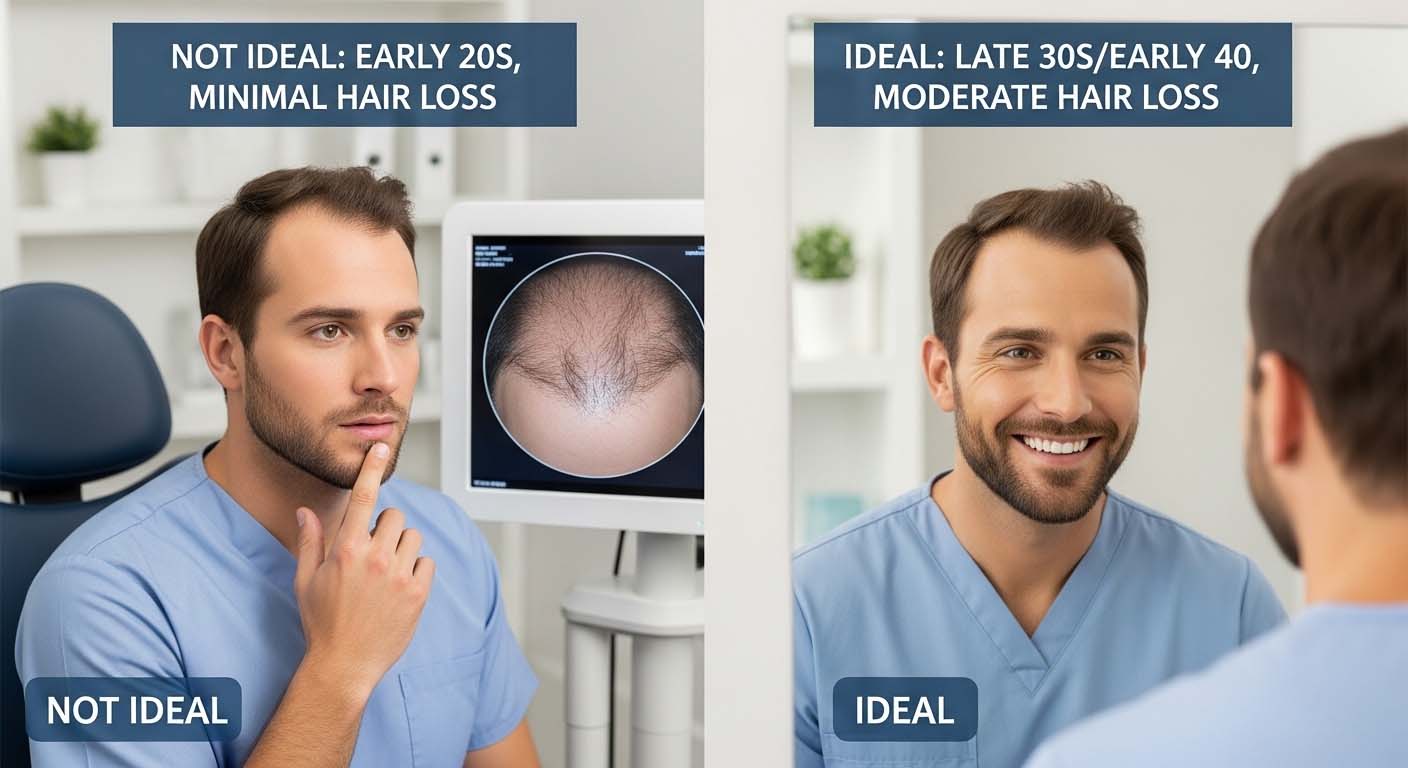
Many young men in their early 20s panic when they first see their hairline receding. But truth be told, this stage is often too early. Why? Because hair loss is unpredictable in your early 20s, and a transplant may not “keep up” with future thinning.
Instead, doctors usually recommend medications like finasteride or minoxidil to slow down the process before even thinking about surgery. According to a study published in the Journal of the American Academy of Dermatology, finasteride can reduce hair loss progression by up to 83% in men under 30 (source).
Late 20s to Early 30s – The Golden Window
Ah, here we go—the sweet spot. By your late 20s and early 30s, your hair loss pattern is more established, and your donor area (the back and sides of the scalp) is usually strong. This makes it the most popular age group for transplants.
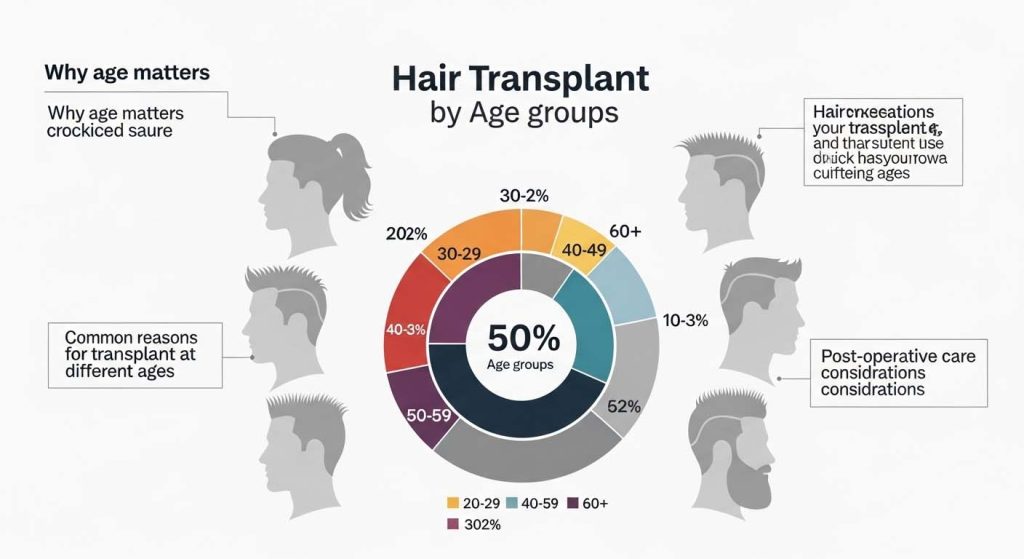
ISHRS data shows that 60% of hair transplant patients are between 26 and 45 years old, with early 30s being the peak demand. Not only do you get long-lasting results, but recovery is often smoother at this age.
In Your 40s – Predictability and Maturity
By the time you hit your 40s, hair loss has usually stabilized, making it easier for surgeons to predict long-term outcomes. Sure, healing may take a tad longer, but with age comes patience, right?
Fun fact: many celebrities who’ve admitted to hair transplants, like Elon Musk and Wayne Rooney, underwent procedures in their late 30s to 40s—and the results speak for themselves.
50s and Beyond – Is It Worth It?
The short answer? Absolutely, if you’re in good health. In fact, some clinics report excellent results for patients well into their 60s. The main considerations here are scalp elasticity, donor supply, and overall health conditions like diabetes or hypertension.
But hey, don’t let age alone stop you. As the saying goes, you’re only as old as you feel.
Other Factors That Matter (Besides Age)
Let’s not put all our eggs in one basket—age isn’t the only deciding factor. Surgeons also consider:
- The extent of hair loss (measured by the Norwood scale).
- Stability of hair loss progression.
- Donor hair availability.
- Lifestyle and health conditions.
Sometimes, waiting until your hair loss stabilizes is smarter than rushing in headfirst.
Medical Evaluation – Don’t Skip This Step
Before you book that flight to Turkey or Dubai (two of the hottest spots for hair transplants), you’ll need a thorough consultation. A reputable clinic will run scalp analyses, check your family history, and evaluate your donor supply. Beware of anyone who says “yes” without looking at the bigger picture—red flag alert 🚩.
Psychological and Lifestyle Considerations
Let’s be honest—hair loss messes with your confidence. A study by the National Library of Medicine found that men with male pattern baldness reported higher levels of self-consciousness and even social anxiety (PubMed Study).
But don’t let emotions cloud judgment. The “ideal” time is not just about age—it’s about making a well-informed decision that aligns with your lifestyle and future goals.
Alternatives Before Surgery
If surgery feels like a leap of faith, there are non-surgical options worth trying:
- PRP therapy (Platelet-Rich Plasma) – uses your blood plasma to stimulate follicles.
- Hair growth medications – minoxidil, finasteride.
- Low-level laser therapy – still debated, but some studies show modest benefits.
- Hair systems or wigs – modern versions look surprisingly natural.
Conclusion
At the end of the day, there’s no one-size-fits-all answer to the “best age for a hair transplant”. While late 20s to early 30s often provide the perfect balance of stability and donor strength, older patients can still achieve remarkable results with the right surgeon and proper planning.
So, before jumping in, weigh your options, consult a qualified specialist, and remember: timing is everything. After all, the goal isn’t just to get more hair—it’s to get results that last a lifetime.
🔑 FAQs: Hair Transplant Timing, Lifespan & Care
1. What is the best age for a hair transplant?
The best age is usually 25–45 years, when hair loss has stabilized and donor hair is healthy.
2. Is 27 too early for a hair transplant?
At 27, it’s often fine if hair loss is stable. Surgeons assess your pattern and may suggest waiting if it’s still progressing.
3. When is the best time for a hair transplant?
The best time is when hair loss has slowed, you’re in good health, and you can commit to post-care. Many prefer cooler months for easier recovery.
4. What happens 10 years after a hair transplant?
Transplanted hair is usually permanent, but natural hair around it may thin. Some patients need touch-ups or medical therapy.
5. What is the lifespan of a hair transplant?
Most transplants last a lifetime since donor hairs resist balding. Results can remain natural for 20+ years with proper care.
6. Can hair transplants fail after 2 years?
Rarely. If graft survival was poor or untreated hair loss progressed, thinning can appear within 2–3 years.
7. Do hair transplants go bald again?
The transplanted hair won’t bald, but existing native hair can. That’s why follow-up treatments (PRP, finasteride, minoxidil) are often advised.
8. How long does a hair transplant take in Turkey?
Typically 6–8 hours, depending on graft numbers. Turkey is popular for affordable, high-volume procedures.
9. Can you wear a hat after a hair transplant?
Yes, but only after 7–10 days, once grafts are secure. Early on, loose surgical caps are usually recommended by surgeons.
10. Does hair density change after 10 years?
Yes. Transplanted hair usually stays, but surrounding natural hair can thin, so overall density may decrease over time.
11. Do hair transplants work for life?
Generally, yes. Transplanted follicles are resistant to balding and can last a lifetime with proper care and stable donor hair.
12. Do transplanted hair fall after years?
Some shedding may happen early, but long-term transplanted hair is permanent. Thinning around it may still occur.
13. Can transplanted hair still turn gray?
Yes. Transplanted hair behaves like your natural hair, meaning it will gray with age just like the rest of your scalp.