
Subtotal ₨ 0
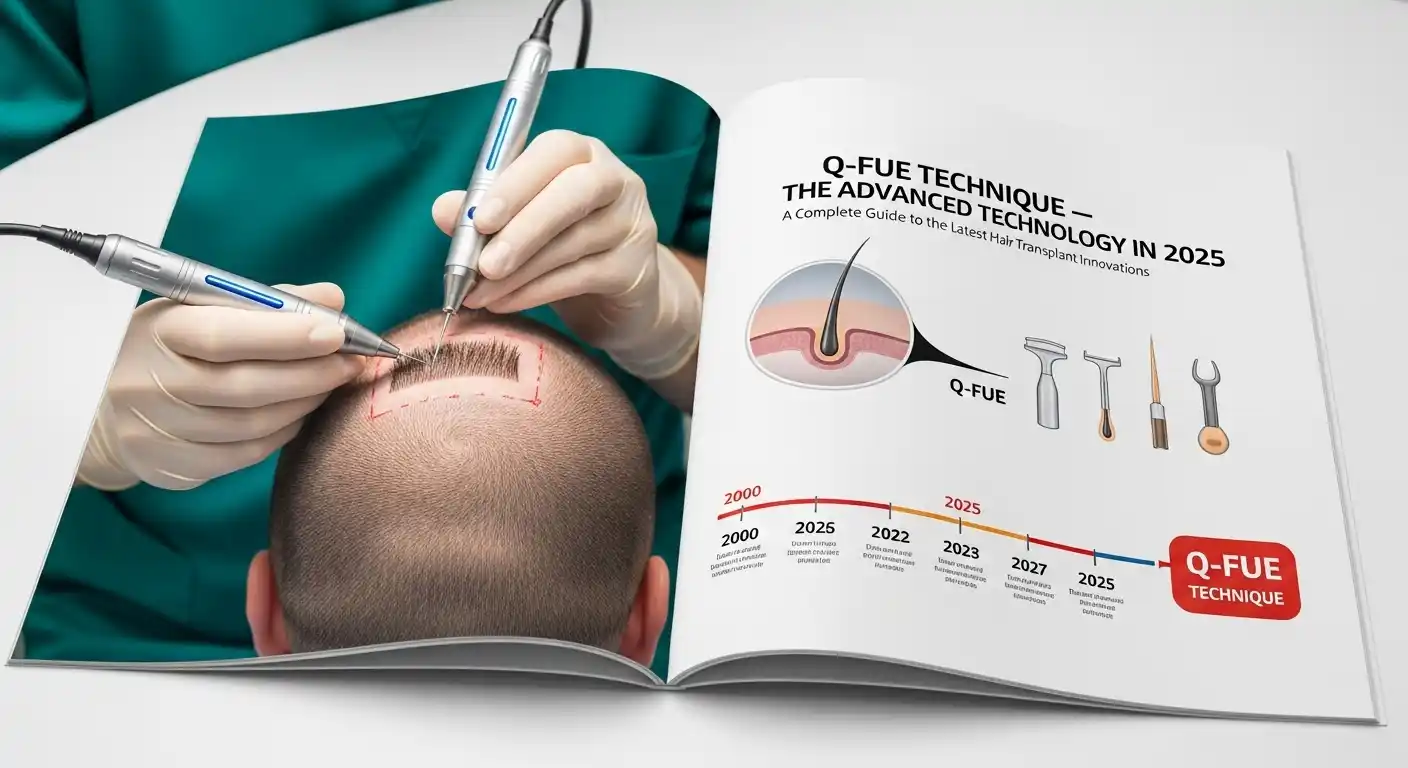
Hair loss—it’s not just about a few extra strands on your pillow. For many, it feels like losing a part of their identity, confidence, and even youth. And let’s be honest, no one wants to stare at their reflection thinking, “Is my hairline playing hide and seek with me?”
The good news? Technology has come a long way. What was once a hush-hush topic has now become a booming $10+ billion industry worldwide. And standing at the front of this revolution is something you’ve probably heard whispers about—the Q-FUE Technique: The Advanced Technology.
A Quick Trip Down Memory Lane
Back in the day, hair transplants meant FUT (strip surgery)—effective, yes, but it left a scar you could spot a mile away. Then came FUE hair transplant, which changed the game with tiny punch tools and faster healing. Patients loved it.
But science didn’t stop there. Enter DHI hair transplant, where follicles are implanted directly using a special pen. Then came Sapphire FUE, using jewel-sharp blades for cleaner incisions. And now? The spotlights on Q-FUE—a sleeker, smarter, and dare I say, more “futuristic” upgrade.
So, What’s the Hype With Q-FUE?

Here’s the scoop: Q-FUE isn’t just another buzzword. It’s an evolution of FUE with better tools, gentler handling of grafts, and super-precise implantation angles. Think of it as the “Tesla” of hair restoration—it’s smooth, efficient, and designed for maximum performance.
- Higher Graft Survival – Studies show follicle success rates hitting 85–95% (source).
- Faster Healing – Most patients bounce back within days, not weeks.
- Natural Look – Hairlines designed with artistry, not cookie-cutters.
- Less Trauma – Your donor area doesn’t look like a battlefield.
In fact, in clinics across Pakistan, success rates are above 90% (source), with patients seeing baby hairs sprouting within 3–4 months and fuller coverage in 8–12 months. That’s pretty impressive, right?
Q-FUE vs The Rest: The Showdown

- Q-FUE vs FUE
FUE is great, but Q-FUE is like FUE 2.0—less trauma, more precision, higher survival. - DHI vs FUE vs Q-FUE
DHI’s implanter pen sounds fancy, but Q-FUE combines the best of both worlds: gentle extraction and controlled placement. - Sapphire FUE vs Q-FUE
Sure, sapphire blades are sharp, but Q-FUE isn’t just about cutting clean—it’s about planting smarter, creating density that looks totally natural. - Artas Robotic Hair Transplant vs Q-FUE
Robots like ARTAS bring AI precision (and hefty price tags—$9,000–$16,000 source). But machines lack the artistic eye. Q-FUE blends tech with a human touch—because let’s face it, no one wants a hairline that looks “computer-generated.”
Why Pakistan is Loving Q-FUE 🇵🇰
Pakistan has quietly become a hub for modern hair transplant techniques. With skilled surgeons, affordable costs, and the adoption of latest hair transplant technology 2025, clinics here are setting international benchmarks. Patients fly in not just from within the country but from abroad, looking for that sweet spot of quality + cost.
The Emotional Side of It
Numbers and tech aside, let’s talk feelings. Hair loss can be devastating. It chips away at self-esteem, social confidence, and even career opportunities. Q-FUE isn’t just about growing hair—it’s about growing back confidence. Imagine looking in the mirror and not avoiding your reflection anymore. Imagine family and friends noticing you, not your thinning crown. That’s the real win
Looking Ahead
The future of hair restoration is only getting brighter. From robotics to AI-guided implants to techniques like Q-FUE that refine the art, the hair transplant industry isn’t slowing down. In fact, it’s expected to hit USD 23 billion by 2031 (source).
But here’s the kicker: while robots may trend, patients will always crave artistry, natural results, and a surgeon’s personal touch. And that’s where Q-FUE shines.
Conclusion
If you’ve been stuck in the DHI vs FUE debate or tempted by flashy terms like “sapphire” and “robotic,” take a moment to explore Q-FUE Technique – The Advanced Technology. It’s not hype; it’s a genuine leap forward.
Hair isn’t just strands—it’s your crown, your identity, your story. And with Q-FUE, you’re not just restoring hair—you’re reclaiming you.
1. What is the advanced FUE technique?
The advanced FUE technique is an upgraded form of Follicular Unit Extraction that uses refined tools and methods to extract and implant hair grafts with higher precision. This results in less trauma, faster healing, and more natural outcomes compared to traditional FUE.
2. What is Q-FUE?
Q-FUE stands for Quality Follicular Unit Extraction. It’s a cutting-edge version of FUE that focuses on maximum graft survival, faster recovery, and natural-looking results. Think of it as FUE 2.0—smarter, safer, and more effective.
3. What is the most advanced technology for hair transplant?
As of 2025, the Q-FUE Technique and Artas Robotic Hair Transplant Technology are considered the most advanced. Q-FUE excels in artistry and natural results, while robotic systems bring automation and precision to follicle extraction.
4. What is the QHT technique for hair transplant?
QHT stands for Quick Hair Transplant. It’s a specialized method designed to reduce the time between follicle extraction and implantation. The shorter the time, the higher the survival rate of grafts—leading to denser and more reliable results.
5. What is the new FUE method?
The new FUE methods include variations like Sapphire FUE, Q-FUE, and DHI (Direct Hair Implantation). These upgrades focus on minimizing scalp trauma, improving graft survival, and achieving natural density.
6. What is the cost of PRP in QHT?
PRP (Platelet-Rich Plasma) in combination with QHT is often priced between PKR 10,000 to 20,000 per session in Pakistan, depending on the clinic and expertise of the surgeon.
7. How much does a 5000 graft hair transplant cost?
In Pakistan, a 5000 graft hair transplant can cost anywhere between PKR 200,000 to 400,000+ depending on the clinic, surgeon’s reputation, and the technique (FUE, DHI, or Q-FUE). Internationally, the same could cost 3–5x more.
8. What is the full form of QHT?
QHT stands for Quick Hair Transplant, a method developed to improve efficiency and graft survival during hair transplant procedures.
9. Why is PRP so costly?
PRP is costly because it requires specialized equipment to extract and concentrate growth factors from your blood, sterile handling, and expertise to inject it properly. Plus, PRP is often done in multiple sessions, which adds up.
10. How much does PRP cost in Pakistan?
On average, PRP therapy in Pakistan costs PKR 8,000 to 20,000 per session, depending on the clinic, city, and package.
11. Is PRP 100% safe?
Since PRP uses your own blood, it’s considered very safe and carries minimal risk of allergic reactions. However, like any medical procedure, minor risks like infection or swelling exist if not done in a hygienic setup.
12. Which is better than PRP?
While PRP is effective for early-stage hair loss, treatments like PRF (Platelet-Rich Fibrin), stem cell therapy, and hair transplants (Q-FUE/QHT) often deliver more long-term and visible results.